
Skip to Content

Best American Science Writing


Note: Search magazine, in which this article originally appeared, closed in 2009 and no longer has a website. I reproduce this article here since you can't find it anywhere else, but any copying, reproduction, extended quotation and other things that count as copyright infringements if done without my permission are, still, prohibited. You could also buy the book.

Reading the Wounds
How doctors treat torture survivors -- and what "counts" as torture?

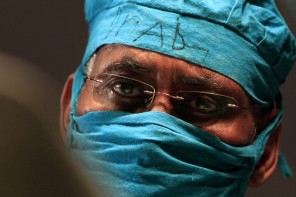
"Mr. A, I need you to take your shirt off.” Dr. Rajeev Bais stretched a pair of latex gloves over his hands. He reached into his pocket and pulled out a paper tape measurer, wound like a tailor’s into a coil. Mr. A sat before him, on an exam table draped in crinkly white paper, at Elmhurst Hospital in Queens, New York.

“I’d like to measure the scars on your back and arms,” Bais said, walking around the table. He moved like he talks, gracefully and deliberately, with an ease that inspires trust. Bais has brown eyes, and what’s left of his black hair is buzzed short. Two gold charms his mother gave him rest near his collarbones: Ganesha, the Hindu elephant god, and Om, the symbol for the sound of the universe.

Mr. A silently slipped his arms out of his sleeves. Bais surveyed his upper body for evidence of cuts, deep bruises or other effects of physical abuse. He zoned in on the arms.

“There’s some scarring here, near your elbows,” Bais said, unrolling his tape measure. “How did that happen exactly?”

“That’s where the cords were,” Mr. A told him.

Bais wrote in his notebook: 5.5 cm by 1 cm linear shaped hyperpigmented scar just superior to the antecubital fossa.

“What about your back?” he asked. “And your shoulder?”

Four small, dark ovals the size of nickels clustered around a thin, straight scar on the left side of Mr. A’s lower back. Bais found two larger, misshapen circles, like stretched-out quarters, on Mr. A’s left shoulder.

“The wooden sticks had sharp objects on them,” Mr. A said.

3cm by 3.5 cm, Bais wrote. Raised.

Bais catalogued six other scars of varying sizes and shapes on Mr. A’s arms and back. When Mr. A removed his pants, Bais found more scarring on the thighs. He knelt to measure a long, uneven mark near Mr. A’s left ankle.

“How did it heal?” he asked. “Was there any bleeding or pus?”

“It bled a lot,” Mr. A answered. “And it swelled up.”

“How long did it bleed?”

“A few months, but not all the time.”

Bais had studied to be an emergency room physician—one of those George Clooney types, suave under pressure, whose days are built of short, intense encounters with car crash survivors, stabbing victims, and people with failing organs. But now he was encountering a kind of stress he had not learned about in medical school.

In their off hours, Bais and his colleagues become forensic physicians: interviewing asylum seekers who say they have been tortured, listening as they explain, over two or three or four hours, what happened to them back home. Then, with physical exams, Bais searches for the scars that can corroborate such stories. If, at the end of all this, the doctors believe the patients’ stories, they write what may be the key to an asylum case: a medical affidavit, the closest thing to proof of torture there is.

Despite the many horror stories Bais has seen, he remains shocked that, actually, torture is rarely unique. There is a set of common practices, and those practices leave distinct interior and exterior scars. Bais and his colleague, Lars Beattie, have taught themselves what those scars might look like, and how to explain torture to judges, who grant the coveted right to remain in America only to refugees who can prove “a well-founded fear of persecution.” The medical affidavits they write are based on a simple idea: that the body tells a story, one that might save a patient’s life. The irony is that this is a modern inversion of precisely the philosophy that brought torture into the world in the first place: that truth can be coaxed from the body.

Bais made a few more notes and told Mr. A he could get dressed. Then he stepped out of the examination rooms and took a deep breath.

****
They just kept saying ‘confess, confess. Confess to Kenya, confess to Riyadh.’ I kept saying the Shahadah [Muslim statement of faith] and they kept beating me and mocking my religion…They told me: ‘We’re going to kill you and bury you here’, and all the time I was wishing that they would.  - Abdul Rahman al-Yaf’I

Torture has always been, in the words of one doctor, “a social institution,” executed for the sake of a cause and on behalf of a people, by practitioners who see themselves as the guardians of those people. From its earliest inception, in ancient Greece, torture was also exclusive: it could be used against some individuals, but not all. “It is [for] the slave,” Aristotle wrote, “and under certain circumstances, the foreigner.”

Never, that is, the vaulted Greek citizen, the legally protected on whose behalf the torture was employed, usually in pursuit of criminal matters. This was no ticking-time-bomb scenario; in ancient Greece and Rome, torture was a method not simply for extracting information, but for purifying it. Slaves and foreigners had to be made worthy of what we would today call offering testimony by suffering for it.

Over time, the relationship between pain and proof took on a religious character. By [WHEN], well after the Romans but [how many] years before the development of a criminal justice system, the ordeal had become a common test of innocence. The assumption was that anyone telling the truth would be strengthened by God and survive; liars, abandoned by God, would get what they had coming.

The twinning of torture and truth found strength in another religious place: the confessional. In 1215, the Fourth Lateran Council made sacramental confession an annual Christian duty. At the same time, Europe was setting up its first modern legal systems, and confession seemed like the best kind of proof of a crime. Witnesses might have poor vision, faulty memories, or untoward motives, and juries could be equally untrustworthy. If self-incrimination was the prerequisite for spiritual absolution, why not also for guilty verdicts? Confession was embraced so fervently by the courts that it became known, in 13th century England, as “the queen of proofs”—and torture became her lackey, a tool officially sanctioned by the state.

If the world of the sacred inspired secular uses for pain, it dallied in endorsing them. Religious directives prohibited clergymen from using torture—but not from cooperating with people who could. To combat religious dissent, its greatest threat in the Middle Ages, the church relied on the state to call it a crime. Europe’s major monarchs outlawed heresy, and the church handed over—rendered, one could say—cases of heresy to jails and courts whose rules of engagement included torture. Eventually, the church eliminated the ban on torture, laying the foundation for the Inquisition.

In France, by the 17th century, torture had become more, even, than this: it was a way of literally uncovering the truth. French jurists believed one’s guilt or innocence could be made manifest physically, in the tortured body of the accused. Rather than coercing confessions from criminals, torture, in leaving injuries whose signs experts would dissect, literally spoke for them.

It is into this long and tangled relationship between pain and truth that Rajeev Bais and Lars Beattie stepped three years ago, when they opened the Libertas Human Rights Clinic. A volunteer project at Elmhurst Hospital in Queens, torture survivors come here for free basic medical care and the affidavits they need for their asylum claims. So far, they’ve treated and written affidavits for nearly 100 people (all of whom, as far as they know, have received asylum).

Medical studies say up to 35 percent of refugee patients doctors treat are likely to have survived torture. An even higher proportion may come through Elmhurst, a public hospital in the country’s most diverse county; 46 percent of Queens residents are foreign-born. “If there’s a place to look for these people,” Beattie says, “it’s Queens.”

The Libertas Clinic and its doctors are part of a loosely-linked world of medical professionals who write affidavits in asylum cases. The medical community first began to notice a proportionally high number of torture survivors among their patients in the late 1970s and 1980s, when refugees fled violence across Central America. In the 1970s, Amnesty International launched an anti-torture campaign, which opened up a conversation in the medical community about how to help survivors.

In 1982, the world’s first center for treating torture survivors was established in Denmark. Three years later, the first U.S. center opened in Minneapolis, which has been a hub for refugee resettlement for the last 30 years. By the 1990s, practitioners on both continents were developing specialized treatment techniques for torture survivors, and researchers began investigating the physiology and biochemistry of the body’s experience during torture.

Today, the National Consortium of Torture Treatment programs links almost 40 health care centers, advocacy organizations, human rights clinics and other organizations, like Libertas, working on behalf of torture survivors in the United States. The International Council for the Rehabilitation of Torture Survivors re-launched the professional journal TORTURE three years ago, at the same time it released a study on medical literature published about torture since 1998. “Perhaps the most important finding is that either torture has increased worldwide,” the study said, “or exposure of torture events has improved.” Whatever the cause, requests for affidavits to members of Physicians for Human Rights’ Asylum Network, a collection of 400 volunteers like Bais and Beattie operating independently in 30 cities, have been increasing for the last four years.

The problem, these doctors have long known, is that there is no instrument for conclusively proving someone’s case. “In order to establish the truth or falsehood of the allegations,” notes from an Amnesty International medical conference in 1978 say, “it would help immeasurably to have available standardized tests that can be easily applied. Physical proof would establish beyond doubt that the alleged torture has in fact occurred.”

Medieval beliefs about the body’s ability to showcase the truth are not, it turns out, so far from modern medicine. In these cases, of course, the allegations are of a patient’s innocence, not a criminal’s guilt, and the relationship is more direct: the question is not what the body says a person has done, but what the body says about what has happened to the body. It’s a welcome tautology.

Each patient who visits Libertas requires a half-dozen or more hours of patient listening and observation. By the time Mr. A jumped up on Bais’ exam table, he had already told Bais he was tortured three times, beaten with wooden sticks, kicked by men wearing military boots, hung upside down from his elbows. But he’d also told Bais about his life before torture, about his new life in America, about the last movie he’s seen. That kind of small talk helps patients feel like their life is normal. And their doctor is normal, too. “We’ll talk about anything,” Bais said, “to show them I’m not some freak really into looking at torture scars.”

*****

Falanga is an overwhelmingly powerful force that works on your whole system. You have the impression of sliding down a vast, shining slope, then you’re flung into a hard granite wall. If you didn’t know they were beating you on your feet it would be impossible to make out where it was coming from. You can see the movements of the torturer. The strokes of the rod are the granite wall. The slope is the interval between each stroke. When there is a regular rhythm to it it’s less painful than when it’s irregular. They are well aware of this subtle variation and they hit you fast and slow, alternately. They beat from heel to toe and back again. They know your first reaction is to arch your feet. They don’t mind you doing this as they know quite well that after a dozen blows your foot will have swollen so much that it fills up your shoe.  --Pericles Korovessis

Bais had to become as much an expert in torture techniques as those who practice them. It was a lonely, self-driven study, and he relies on the field’s canonical texts: the Istanbul Protocol, the 1998 United Nations manual on how to conduct interviews and physical and psychological exams of survivors, and Examining Asylum Seekers, a manual for physicians and psychologists written in a dissonant combination of medical jargon and torture slang. The “parrot perch,” it explains of the nickname for a kind of suspension torture, is “the suspension of a prisoner by the flexed knees with a bar passed below the popliteal region, , usually with the wrists tied to the ankles. It may produce tears in the cruciate ligaments of the knees.” Which is a specialist’s way of saying if you find tears in the cross-shaped tissue that keeps the shinbone and the calf bone from banging into each other, you’ve probably got a patient who was bound and hung from his knees over a rod.

These books give best-case diagnostic scenarios, which require no specialization for diagnosis. Electrocution, for example, is straightforward. What happens to the body when voltage rushes through it is pretty universal: muscles cramp and form scarred bundles, and raised scars often appear where the current entered the body. But diagnostic proof, medicine’s version of “beyond a reasonable doubt,” doesn’t last forever. After electrocution, calcium deposits on the outermost layers of skin—deposits that get there only only when current passes through—may linger, but not longer than a week. Even on patients who have endured severe trauma, treatment books warn, doctors are unlikely to find diagnostic evidence.

The best doctors like Bais and Beattie can do is look for the kinds of marks they know specific torture techniques might leave. Pounding the ears with cupped hands, a method known as telefono, might pop an ear drum, leaving scar tissue. Beatings on the soles of the feet—falanga—might kill the heel’s soft tissue. But it’s also possible not to find anything. Unless a bone breaks, a joint pops, or nerves and muscles are damaged, the body keeps silent about its trauma.

Torturers know this. They also know putting a shoe on someone’s foot before beating it with a lead pipe spreads out every blow, lessening the chance of destroying tissue, and that putting a wet towel between the skin and, say, a cattle prod usually prevents the electrical current from leaving a long-lasting mark. Suspension hanging—dangling someone from their ankles or wrists or knees, known during the Inquisition as the “queen of torments”—is infamous for its absence of physical evidence, and practiced, because of that, around the world.

There may be, some doctors think, an underground conversation happening about how to cause pain without scarring. “Somebody somewhere said, ‘This is a good way to make people suffer,’” Beattie, who’s now head of the clinic, said. If so, the conversation seems to be regional. Telefono is popular in Peru but almost unheard of in Iran, where falanga is something of a standard operating procedure. Near-suffocation with water is so common in Latin America that it is known, here, by an English and Spanish hybrid: “wet submarino.”

Given the level of sophistication torturers practice, Beattie wasn't surprised that most of the physical evidence of torture had disappeared from the body of Mr. Y., one of his earliest patients. Mr. Y was arrested in 1995 and imprisoned in Chechnya, where police officers tightened plastic bags around his head until he nearly suffocated, according to his interview with Beattie. They beat him with soda bottles, one-third full of water, a half-dozen times a day. At one point, they tied his wrists behind his back, pulled his arms over his head, and hung him from the ceiling. And they used something like a water-dropper to apply a liquid that made his back feel “like it was burning.”

But few scars are left. Beattie found clusters of warts on his neck and chest. He measured them and felt them with his fingertips. Then he wrote: Multiple small 1-2cm diameter raised hard keloids on the neck and torso. They are raised and rubbery in texture. There is no surrounding erythema or induration. The lesions are not fluctant.

In other words, the thick, circular scars are still the same color as his skin, which means the capillaries weren’t permanently damaged by whatever caused the scarring. They haven’t hardened permanently, and they don’t shift under pressure. Based on that evidence, Beattie concludes, Mr. Y was likely burned, probably with an acid or a base—just as he had told Beattie.

At this point, when the scars confirm the story, Beattie usually writes the first draft of his affidavit. But with Mr. Y, he hesitated. He concedes that what happened to Mr. Y sounded pretty bad, and yet: “I mean, the guy is from the Caucuses,” Beattie says later. “But the Chechens are no angels either. There’s torture on both sides.” He pauses. “So is this guy really a good guy to let into the country?”

**

[In the crucifix position], it was as if my arms were coming off….The pain became so bad that my screams drowned [the torturers’] voices….Even when they stopped torturing you physically, the screams of others began to torment you psychologically. After a while, I was able to pick out which torture was being applied from the screams.  --Sema Ogur

Lars Beattie would never describe himself as powerful. He’s six feet tall and still, at 40, a little gangly, with a scruffy goatee, wide, green eyes and sandy hair that flops over his eyebrows. He speaks softly, in six- or seven-word spurts, and turns his eyes down when he has to say gruesome things like, “They burned him with a hot machete on his thigh.” When he’s not stitching people up in the ER, or at the clinic, Beattie paints, or makes furniture, or tries to be a good dad.

Beattie resists being characterized as powerful;; the judge, after all, decides who stays in the States and who’s deported, and Beattie’s never even met an asylum judge. When pressed, he conceded only, “I guess I make some sort of decisions about people.”

It is, often, on the basis of the decisions he makes that a refugee like Mr. Y is allowed to stay in America. An affidavit carries a great deal of weight in the asylum process. To win asylum, a person has to prove that going home threatens his life, by virtue of his membership in an at-risk social group. Some risks are clear—think sending Kurdish refugees back to Saddam Hussein’s Iraq—but most require stacks of substantiating paperwork.

The medical affidavit is often the most powerful in that stack because it functions as tacit proof of torture. Essentially, the doctor who writes it is saying, “I believe this guy,” though no Libertas Clinic affidavit uses that vocabulary.” The most the doctors there will do is lay out two parallel stories, one told by the torture survivor and one by his or her body. When the scars and stories match, they write, “The scarring is consistent with the mechanism of injury.”

The key to the match is how a scar heals. It’s hard to mistake the raised, misshapen circular scar of a cigarette burn, for example, for anything else; nicotine ruins its edges and leaves the skin looking curdled. Gashes left by whipping give clues about how much force went into the abuse; internal scar tissue suggests, by its position and intensity, its perpetrator.

Beattie acquired most of his knowledge observing scars from ordinary medical resources: on-the-job experience dealing with accidental injuries he sees in the ER, and med school textbooks. He swears by Wounds and Lacerations, which describes how virtually every kind of abrasion looks when it heals well and when it heals poorly. Knowing the difference helps him figure out who’s telling the truth. “It’s hard to fake how a knife cuts you,” he said, “the way it comes in, how it heals.”

Bodies, in other words, can expose a lie. One doctor in Manhattan interviewed a man who claimed the scars above his nipples were the result of torture he suffered in Liberia under Charles Taylor’s regime. But the scars were symmetrical and equidistant, implying a precision which raised the doctor’s suspicion. A Liberian culture organization to which he described the markings told him the scars were evidence of a tribal ritual ceremony.

After dozens of affidavits—a 19-year-old woman from Mali with female genital mutilation; a Tibetan tortured with electric cattle prods 15 years ago; a man from the Ivory Coast burned with a machete and hung from his wrists—Beattie has learned the signs of a well-planned lie. Usually, how the patient tells a story tips off what Beattie calls “the gut gestalt,” which he’s honed after seeing so many schemers in the ER.

“I think people imagine torture in a comic book type way. They say, ‘Oh, look at this scar here. And I’ve also got this one!’” he said. “ People who’ve gone through this generally have a huge psychological burden to get off their chest. They say, ‘Well, it all started when…’ They try to work through what happened to them in a storybook kind of way. And you’re emotionally invested.”

But sometimes, as in Mr. Y’s case, the emotional investment doesn’t seem to be quite enough. Beattie never doubted his story, but he did wonder about the moral equivalence pain: who’s to say, he wondered, that Mr. Y never inflicted brutality on someone else? There’s no room in legal proceedings for that kind of question, though; the standards of proof in courtroom, rather than the questions of Bettie’s conscience, dictated his decision. "I decided, look, I believe him as a human being. I believe he was victimized there," Beattie says. "And I believe I'm doing the right thing by writing the affidavit. But you know, I'm sure—" He pauses. "Other people might feel otherwise."

**

One practice…was ‘short shackling’ where we were forced to squat without a chair with our hands chained between our legs and chained to the floor. If we fell over, the chains would cut into our hands. We would be left in this position for hours before an interrogation, during the interrogations (which could last as long as twelve hours), and sometimes for hours while the interrogators left the room. The air conditioning was turned up so high that within minutes we would be freezing. There was strobe lighting and loud music played that was itself a form of torture.  -Shafiq Rasul and Asif Iqbal

In the United States, there has been of late little agreement about what torture actually is. Part of the disagreement stems from the epistemological problem of pain. Severe pain confounds language; it leaves its sufferer grasping for similes, metaphors and analogies that can only approximate the feeling and intensity of pain. “To have great pain is to have certainty,” writes Elaine Scarry, a literature professor at Harvard University, in her landmark book The Body in Pain. “To hear that another person has pain is to have doubt.”

Much of that doubt, these days, is political. The debate in America about what counts as torture is rarely about what actually happens to the body and more about whether the end, the extraction of vital national security information, is justified. We avoid thinking about what “short shackling” means and concentrate instead on what we hope it will get us: What if the shackled suspect knows something about the planning of the September 11 attacks? What if he knows but refuses to name someone who wanted to set off a dirty bomb? What if, in fact, that dirty bomb is out there somewhere, its ignition clock ticking away the seconds until explosion, while we dither about the Geneva Conventions?

In his Justice Department memo offering the Bush Administration the leeway it sought to undertake harsh interrogations, extraordinary renditions, and other now familiar practices on a contested continuum of torture, John Yoo wrote, “Torture is not the mere infliction of pain or suffering on another…The victim must experience intense pain or suffering of the kind that is equivalent to the pain that would be associated with serious physical injury' so severe that death, organ failure, or permanent damage resulting in a loss of significant body function will likely result.” It doesn’t count as torture, the U.S. government seemed to say, unless it almost kills you.

Often the only people standing between the “mere infliction of pain and suffering” and near-death torture are, ironically, doctors. Steven Miles, a professor of internal medicine at the University of Minnesota, combed through 35,000 pages of government documents released under the Freedom of Information Act to understand the role medical personnel had played in military interrogations in Guantanamo, Iraq and Afghanistan. “They were supposed to make sure this man has his medications available during harsh interrogation,” he said, “make sure his blood pressure stays under such and such—that kind of thing.” In his 2006 book Oath Betrayed: Torture, Medical Complicity and the War on Terror, he quotes from directives he found by former Secretary of Defense Donald Rumsfeld insisting harsh interrogations take place only with “the presence or availability of medical personnel.” Miles also found more than 200 military studies, by his count, that concluded the intelligence torture elicits is usually faulty.

Compartmentalizing torture into medically measurable units—a pulse rate, or blood pressure level, or lung capacity or brain activity—suggests that even the most extreme of physical experiences can be approached in a routine way. And in fact, the physical experience of torture is, in some ways, generic. Skin doesn’t burn any faster or more deeply in a prison cell than on a hot stove, and its wounds don’t heal any more quickly if they weren’t deliberate.

What makes torture a unique kind of pain—what makes torture torture—is the premeditation of the person committing the abuse. It is, in the words of one treatment center, “the intentional and systematic infliction of physical or psychological pain and suffering in order to punish, intimidate or gather information.” In other words, the torturer has to want to something. This isn’t so different than the circumstances in which torture first sprung up, hundreds of years ago. Then, as now, torture was the infliction of suffering in service of the state. And as soon as pain becomes an exercise in political power, the debate about the definition of torture is over.
***

I am just like a chook (small aquatic plant) in the middle of the river or the sea. My life is empty. Every move I make, sitting, sleeping, walking and standing, I feel as if I am all alone....This feeling is still with me. But I try to forget about this feeling…

-“CL”

Some patients who come to Libertas have reassembled their lives; others are still fragile, years after their experience. There’s no manual that tells Rajeev Bais or Lars Beattie how quickly their patients “should” heal; like the physical scars they seek, the mental and emotional scars of torture can linger, seemingly silent.

In fact, how quickly survivors recover might depend on why they think they suffered. Medical studies have found that torture survivors who believed they were beaten in the name of a noble cause more easily readjust to ordinary life than those who were arrested in a random sweep or a case of mistaken identity. “Two people can feel the same amount of pain and suffer to different degrees,” says Dr. Frank Vertosick, a neurosurgeon and author of Why We Hurt: A Natural History of Pain. “It’s the Joan of Arc phenomenon. I know I’m doing this for a cause, so the pain is just the pain.”

The cause gives the experience a greater meaning that not only helps people recover from torture, some doctors say, but also to live through it in the first place. It’s less about what’s felt and more about how it’s perceived.

All pain is, in fact, perception. Vertosick says pain is a sensation, like noise or taste or sound. Its signal is interpreted by the thalamus, at the base of the brain, and on its own, means nothing to the body. But when the signal travels and is interpreted by the brain’s frontal lobes, the physical experience the body is having becomes what we describe as painful. Ultimately, the brain decides that pain hurts, and how much it hurts.

Whether being hung from the wrists or being forced to squat for hours at a time—both considered categories of suspension torture—“hurts more” depends on how the person being suspended interprets the experience.

“Some pain is positive—ritual pain, for instance. It has a positive meaning. So why is torture so harmful?” asked Victor Iacopino, a senior medical advisor to Physicians for Human Rights who wrote the Istanbul Protocol, in an interview. “People are harmed because of the meaning torture has to them. Because they had to betray loved ones, friends, colleagues in order to survive. Because it’s degrading.”

Almost all of the patients who have come to the Libertas Clinic suffer from post- traumatic stress disorder. Almost all suffer from depression. Most tell their doctor that they’re uninterested in the world or that they can’t trust it. Beattie refers them to psychologists, but he wonders how they ever really recover. “A burn heals, the pain goes away. But if somebody took my hand and held it to the stove,” he says, “if somebody did that to me, it’s going to hurt a lot longer.”

The seeming impossibility of recover is what makes his patients’ resilience so incredible to Lars Beattie. He has heard enough gruesome details to his subconscious for the rest of his life, but there’s one in particular he remembers, one which resurfaces, over and over: a West African man was locked, naked, in a metal shipping container for 15 days. His wrists were bound to his ankles, his thighs burned with a hot machete. Until he managed the unthinkable.

“He escaped. He walked without clothes to the border…and he manages to get here, with nothing,” Beattie says with wonder in his voice. “He’s gone through all this…and every day he gets up and sells his wares. He gets on with his life.”

He stops and shakes his head at the utter implausibility of what he is about to say. “The power to recuperate is amazing.”

Post Script:

The voices of torture survivors in this article have been gathered from around the world, over the last 40 years.

Yaf'i survived four months in prison in Jordan, after his extraordinary rendition by Egypt, possibly in collaboration with the United States. His story appears in Amnesty International's April 2006 report, "USA: Below the Radar -- Secret flights to torture and disappearance."

Pericles Korovessis was tortured by the Greek junta in 1967; he tells his story in his 1969 book, "The Method."

Sema Ogur was a student detained twice by the Turkish government, for a total of 47 days. Her husband was also arrested and tortured. Her story appears in Bulletin No. 1, 1984, of Amnesty's Campaign to Abolish Torture.

Shafiq Rasul and Asif Iqbal, both British nationals, issued a joint statement describing their imprisonment by American authorites at Guantanamo Bay, Cuba, in an open letter to the U.S. Armed Services Committee in 2004.

"CL" is a Cambodian genocide survivor whose story is included in the archives of the Cambodian-American Women Oral History Project, at the Radcliffe Institute for Advanced Study at Harvard University.

Like what you read? Get updates for free!

No Responses to “Best American Science Writing” Leave a reply ›

Leave a Reply

Where I am

Archived Posts at JinaMoore.com